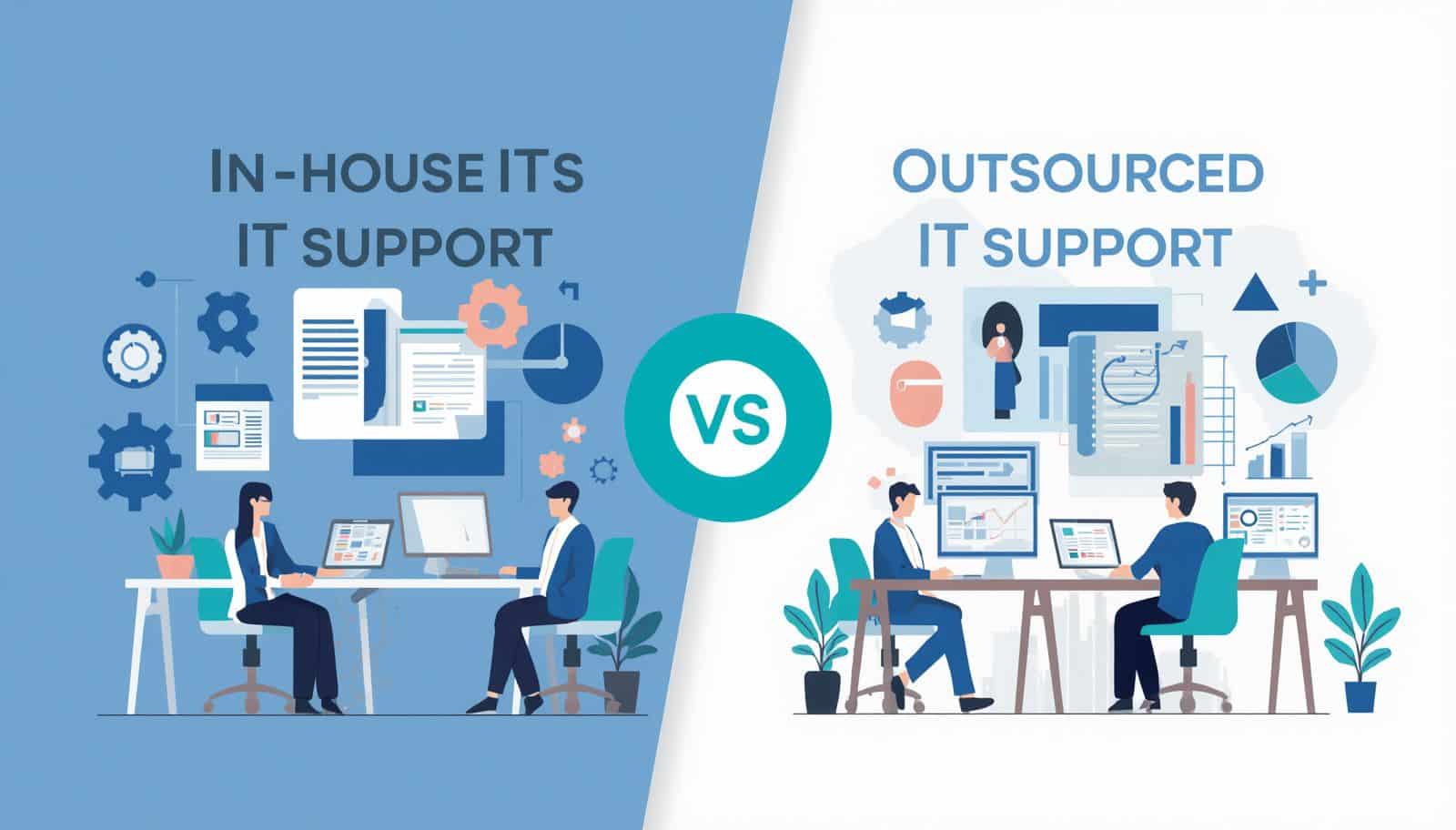

When your business reaches the point where technology needs proper management, you face a decision that can have a significant impact on your costs, productivity, and growth. Do you hire an in-house IT professional, or do you partner with an outsourced IT support provider?
Both options have their merits, and the right choice depends on the size, needs, and ambitions of your business. This post breaks down the key differences to help you make an informed decision.
What Is In-House IT Support?
In-house IT support means employing one or more dedicated IT staff members directly within your business. They work on-site, get to know your systems inside out, and are available whenever something goes wrong.
For larger organisations with complex, bespoke infrastructure, having dedicated internal resource can make a lot of sense. But for small and growing businesses, the costs and limitations of this model are often difficult to justify.
What Is Outsourced IT Support?
Outsourced IT support, often delivered through a managed service provider, means partnering with an external company to handle some or all of your IT needs. This can include everything from day-to-day IT helpdesk services and network monitoring to cybersecurity, backup solutions, and strategic IT planning.
Rather than relying on a single individual, you gain access to an entire team of specialists, typically for a fixed monthly fee.
Comparing the Two Models
Cost
This is often the first consideration for business owners, and it’s where outsourced IT support has a clear advantage for most small and mid-sized businesses.
Hiring a mid-level IT professional in the UK costs anywhere from £30,000 to £45,000 per year in salary alone, before you factor in National Insurance contributions, pension, holiday cover, training, and the risk of that person leaving. A single IT employee also can’t cover every specialism your business might need, meaning you may still need to bring in external help for certain issues.
Outsourced IT support provides access to a full team of specialists at a fraction of that cost, with predictable monthly pricing that makes budgeting straightforward.
Availability
An in-house IT employee works set hours. If something goes wrong outside of those hours, your business is exposed. Cover for holidays, illness, and staff turnover adds further risk and cost.
A managed IT support provider offers consistent availability, often including out-of-hours monitoring and support. Your systems are watched around the clock, and there’s always someone available to respond when issues arise, regardless of whether it’s a bank holiday or the middle of the night.
Breadth of Knowledge
A single IT hire brings their own experience and skill set, which may not cover everything your business needs. Cybersecurity, networking, cloud infrastructure, compliance, and hardware support all require different areas of expertise.
With outsourced IT support, you benefit from a team with diverse and up-to-date knowledge across all of these disciplines. As technology evolves, your provider evolves with it, ensuring your business always has access to current best practice without the need for ongoing training investment.
Response Times
One argument in favour of in-house IT is having someone physically present when problems occur. There’s no doubt that having a person on-site can be reassuring, particularly for businesses that rely heavily on physical infrastructure.
However, modern managed IT support providers resolve the vast majority of issues remotely and often faster than an on-site engineer could. With remote monitoring tools, many problems are identified and fixed before they even impact your team. For issues that do require a physical presence, most providers offer on-site support as part of their service.
Scalability
As your business grows, your IT needs grow with it. Scaling an in-house team means going through the time-consuming and expensive process of recruiting again. You’re also limited by how quickly you can onboard new staff.
Outsourced IT support scales with your business naturally. Whether you’re adding new employees, opening additional offices, or adopting new technology, your provider can adapt quickly without the overhead of additional headcount.
Strategic Input
IT shouldn’t just keep the lights on, it should actively support your business goals. In-house IT staff are often so focused on day-to-day maintenance and firefighting that longer-term strategic planning falls by the wayside.
A good managed IT support partner takes a proactive approach, helping you plan your IT roadmap, identify opportunities to improve efficiency, and align your technology with where your business is heading. This kind of strategic input is difficult to get from a single in-house hire.
So Which Is Right for Your Business?
For most small and mid-sized businesses, outsourced IT support offers better value, greater expertise, and more flexibility than building an in-house team. It removes the risks associated with relying on a single individual, provides access to a broader range of skills, and allows your leadership team to focus on running the business rather than managing technology.
That said, in-house IT can be the right choice for larger organisations with very specific, complex, or sensitive infrastructure requirements that benefit from dedicated on-site resource. Some businesses also choose a hybrid model, combining a small internal IT function with an outsourced provider for specialist support and out-of-hours coverage.
Making The Right Choice for Your Business
There is no one-size-fits-all answer, but if you’re a growing business looking for reliable, cost-effective, and scalable IT support, outsourcing is almost always the smarter choice.
At TechWise Support, we work with businesses of all sizes to deliver proactive, responsive, and expert IT support tailored to their needs. Whether you’re looking to replace an underperforming in-house setup or exploring managed IT support for the first time, we’d love to help.